The Egyptian Arcana: When Victorian England Fell in Love With Egypt (And Invented Tarot's Origins)
<p>In 1781, a French Protestant pastor named Antoine Court de Gébelin published a breathtaking claim: tarot cards were actually ancient Egyptian hieroglyphs, rescued from the flames that consumed the great libraries of Alexandria, containing the purest mystical wisdom of Egyptian priests. He offered exactly zero evidence for this theory. He had never been to Egypt. He couldn't read hieroglyphs—no European could yet. He was completely, absolutely, magnificently wrong.</p>
<p>And his beautiful lie changed tarot forever.</p>
<p>The Egyptian Arcana deck celebrates that gorgeous mistake—the moment when European imagination collided with Egyptian mystery and created something entirely new. This isn't a deck claiming authentic Egyptian spirituality. It's a love letter to Victorian Egyptomania, that fevered cultural obsession when Europe decided Egypt held all the secrets they'd been searching for.</p>
<h2>The Invention of Egyptian Tarot</h2>
<p>Court de Gébelin's theory appeared in his massive encyclopedia <em>Le Monde primitif</em>, buried in volume eight among essays on universal grammar and the origins of language. When he first encountered tarot cards—watching women play with a Marseille deck—he experienced what he described as immediate recognition: "I cast my eyes, and immediately recognize the Allegory."</p>
<p>What he "recognized" was pure invention. He claimed tarot meant "Royal Road" in Egyptian (it doesn't—tarot comes from Italian tarocchi, probably from the Arabic word turuq, meaning "ways"). He said Egyptian priests had distilled their wisdom into these images and smuggled them to Rome, where popes secretly guarded them before bringing them to Avignon in the 14th century.</p>
<p>The actual history? Tarot originated in 15th century Italy as playing cards for a trick-taking game. The mystical imagery Victorian occultists found so Egyptian was added by European artists drawing from medieval Christian symbolism, classical mythology, and Renaissance allegory. Nothing Egyptian about it.</p>
<p>But Court de Gébelin's timing was perfect. Napoleon had just invaded Egypt in 1798, bringing back not just military defeat but crates full of artifacts and the scholars who would eventually decipher the Rosetta Stone. Europe was primed for Egypt fever. When scholars finally did decode hieroglyphs in the 1820s, they found nothing supporting Court de Gébelin's etymologies—but by then, the damage was done. Every occultist who came after him, from Éliphas Lévi to Arthur Edward Waite, built their tarot systems on this Egyptian foundation that never existed.</p>
<h2>Egyptomania Takes Hold</h2>
<p>The 19th century saw Europe in the grip of full-blown Egyptomania. Napoleon's 1798 Egyptian campaign brought back not just artifacts but an entire scholarly mission that produced the monumental <em>Description de l'Égypte</em>—detailed documentation of Egyptian monuments, culture, and history that made Egypt feel simultaneously ancient and accessible.</p>
<p>The Rosetta Stone's discovery in 1799 and Jean-François Champollion's breakthrough decipherment of hieroglyphs in 1822 transformed Egypt from mythical past to recoverable history. Suddenly Europeans could read what Egyptians had written—and what they found fascinated them. The sophistication of Egyptian medicine, mathematics, astronomy, and engineering challenged Victorian assumptions about progress and civilization.</p>
<p>But it was the discovery of Tutankhamun's tomb in 1922 that brought Egyptomania to fever pitch. Howard Carter's excavation captured worldwide attention—here was Egypt made tangible, touchable, real. The intact treasures, the golden mask, the "wonderful things" Carter described seeing by candlelight—all of it fed European hunger for Egyptian mystery.</p>
<p>Egyptian motifs appeared everywhere: in architecture (obelisks in city squares), furniture design (sphinx-footed chairs), jewelry (scarab bracelets), even cigarette advertisements. Museums raced to acquire Egyptian collections. Wealthy tourists flocked to Cairo and cruised the Nile. Egyptian themes dominated costume balls and theatrical productions.</p>
<p>Occultists claimed Egyptian wisdom undergirded Western mysticism. Freemasons adopted Egyptian symbols. Theosophists invoked Isis and Osiris. Spiritualists held séances to contact Egyptian priests. Everyone wanted a piece of Egypt—or at least the Egypt they imagined.</p>
<h2>Orientalist Painting: Europe's Fantasy Egypt</h2>
<p>Into this cultural moment stepped the Orientalist painters—European artists who traveled to Egypt, North Africa, and the Middle East, then returned to their Paris studios to create lavish paintings of what they'd seen. Or thought they'd seen. Or wished they'd seen.</p>
<p>Jean-Léon Gérôme (1824-1904) became the face of this movement. He made multiple trips to Egypt beginning in 1856, sketching architectural details, photographing mosques, collecting costumes and artifacts. Back in Paris, he combined these observed details with idealized figures painted from European models to create scenes that felt simultaneously documentary and fantastical.</p>
<p>His paintings show meticulous archaeological accuracy in architectural elements—every tile pattern correct, every hieroglyph placed properly—combined with romanticized figures and dramatic lighting that owed more to European theatrical tradition than Egyptian reality. The effect was intoxicating: viewers felt they were seeing authentic Egypt while actually encountering European fantasy dressed in Egyptian costume.</p>
<p>Other Orientalist masters contributed to this visual vocabulary. John Frederick Lewis (1804-1876) spent years in Cairo, painting intimate courtyard scenes with extraordinary architectural detail. Lawrence Alma-Tadema (1836-1912) brought archaeological precision to his classical and Egyptian subjects, making ancient worlds feel tangible. These weren't cynical fabrications—these artists genuinely studied their subjects—but they filtered everything through European aesthetic sensibilities.</p>
<p>The Orientalist style is instantly recognizable: rich, saturated colors; dramatic chiaroscuro lighting; meticulous architectural detail; idealized human figures; and an atmosphere of mystery and exoticism. It's Victorian England's Egypt, painted for Victorian audiences who craved both education and entertainment.</p>
<p>The Egyptian Arcana deck's Fool and Empress cards embody this tradition—figures rendered with Orientalist painting's characteristic blend of observed detail and romantic imagination. These aren't attempting authentic Egyptian representation. They're celebrating the Victorian European interpretation of Egypt, complete with all its gorgeous misconceptions.</p>
<h2>Authentic Egyptian Visual Language</h2>
<p>But what did Egypt actually look like? The contrast between Orientalist fantasy and authentic Egyptian art reveals just how much Victorian imagination transformed what it saw.</p>
<p>Egyptian tomb painting and temple relief followed strict conventions developed over three millennia. Figures appear in composite view—head in profile, eye frontal, shoulders frontal, torso in profile, legs in profile. This wasn't lack of skill but deliberate choice: each part of the body shown from its most recognizable angle, creating clarity rather than naturalistic depth.</p>
<p>Colors carried symbolic meaning rather than representing observed reality. Skin tones indicated gender and status: men in red-brown, women in pale yellow, gods in gold or blue. Green symbolized regeneration, black represented fertile Nile soil and regeneration, white suggested purity and sacred objects. Every choice was coded.</p>
<p>Scale indicated importance, not spatial relationships. Pharaohs tower over ordinary people. Gods dwarf humans. The most significant figures dominate compositions regardless of actual size relationships. Perspective as Europeans understood it simply didn't apply—these were conceptual maps of meaning, not optical records of space.</p>
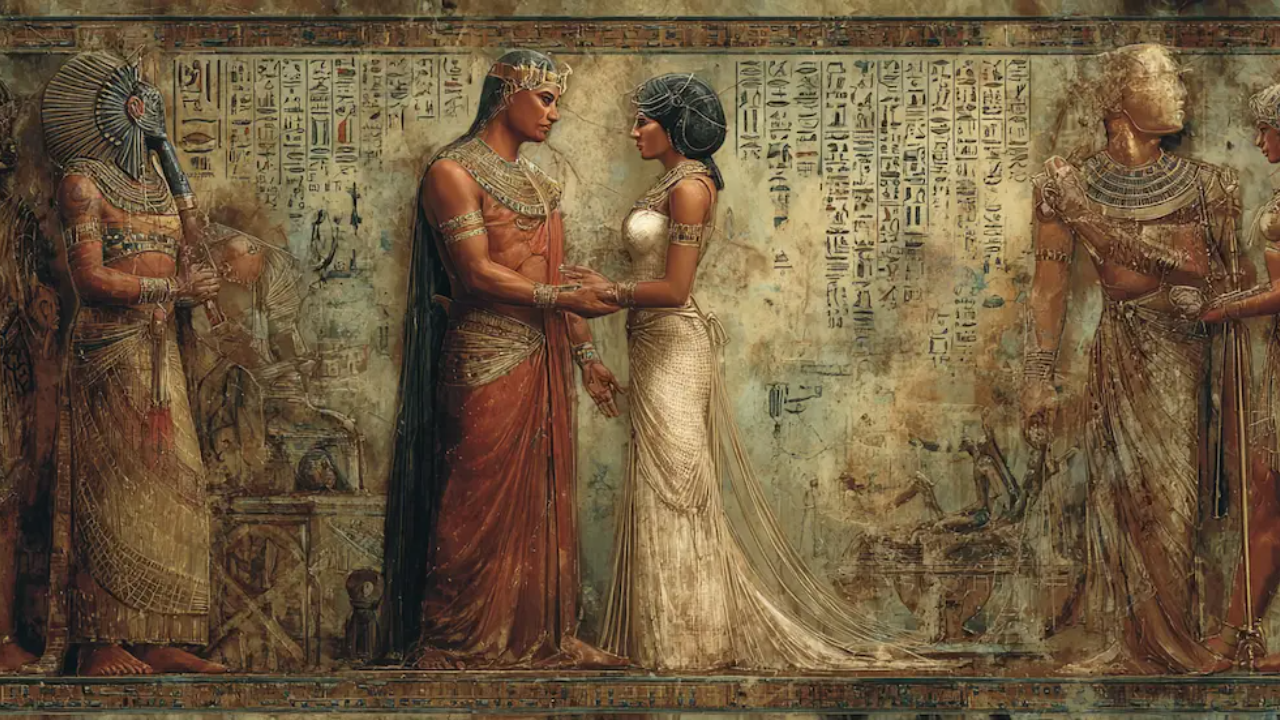
<p>The Lovers card in the Egyptian Arcana deck employs authentic hieratic style—flat perspective, symbolic color use, figures in profile, hieroglyphic text integrated into composition. This visual language speaks Egyptian, not Victorian fantasy about Egypt. The contrast with the Orientalist cards is deliberate: here's what Egypt actually looked like, here's what Victorians imagined it looked like. Both are beautiful. Both are valid. Both inform Western tarot tradition.</p>
<h2>The Papyrus Aesthetic</h2>
<p>Unifying both artistic traditions is the aged papyrus texture that frames every card in this deck. Papyrus—that ancient writing material made from Cyperus papyrus reeds growing along the Nile—became shorthand for Egyptian authenticity in Victorian imagination.</p>
<p>Real papyrus documents survive from ancient Egypt, preserved by the dry desert climate. The British Museum and Metropolitan Museum house extensive papyrus collections—everything from administrative records and legal contracts to religious texts and literary works. Victorian excavators prized these finds, both for scholarly value and romantic appeal.</p>
<p>The texture itself tells a story: fibrous, slightly irregular, showing the horizontal and vertical layers of pith strips that ancient scribes pressed together to create writing surfaces. The aged, weathered quality suggests archaeological discovery—these images feel like they've been unearthed, not created.</p>
<p>The hieroglyphic cartouches framing each card reinforce this archaeological atmosphere. Cartouches—those oval frames containing royal names—were among the first hieroglyphic elements Europeans learned to recognize. They signaled "this is Egyptian" to Victorian audiences the same way they do on these cards: visual markers of authenticity, regardless of whether the content is historically accurate.</p>
<p>The scarab beetles adorning each card's border serve double purpose: aesthetic unity and pedagogical design. Each suit's scarab carries subtle differentiation—variations in wing position, orientation, or style that train the eye to recognize patterns. This isn't accidental decoration. It's teaching visual literacy through repeated exposure, building the exact skill tarot reading requires: noticing meaningful differences in symbolic language.</p>
<p>This papyrus aesthetic does double duty: it satisfies Victorian hunger for archaeological legitimacy while creating visual cohesion across disparate artistic styles. Whether viewing Orientalist painting or authentic hieratic art, the papyrus frame signals "this belongs to Egypt's visual world."</p>
<h2>Why the Fantasy Felt True</h2>
<p>Court de Gébelin was wrong about tarot's Egyptian origins—but he wasn't entirely wrong about everything. The reason his theory took hold and persisted for over two centuries is that it pointed toward something genuine: universal archetypal patterns that appear across cultures.</p>
<p>Carl Jung, the Swiss psychiatrist and psychoanalyst, proposed that beneath individual consciousness lies the collective unconscious—a shared reservoir of universal patterns, symbols, and archetypes that transcend culture and time. These aren't learned or cultural but fundamental patterns of human experience: the Hero, the Mother, the Trickster, the Wise Elder, Death and Rebirth.</p>
<p>Tarot's Major Arcana function as archetypal journey—The Fool's transformation from innocence to wisdom, The Hermit's solitary seeking, Death's necessary endings, The Star's renewed hope. These patterns appear in Egyptian mythology just as they appear in Greek myth, Norse sagas, Chinese philosophy, and every other cultural tradition. Not because they borrowed from each other, but because they reflect genuine patterns in how humans experience existence.</p>
<p>When Victorian occultists looked at tarot cards and saw Egyptian wisdom, they were recognizing—however mistakenly—that the archetypes depicted transcended their medieval Italian origins. The Empress could be the Egyptian goddess Isis or the Christian Virgin Mary or the Daoist concept of receptive yin. The archetype remains constant; only the cultural clothing changes.</p>
<p>Jung believed symbols communicate directly with the unconscious mind, bypassing logic and language. This is exactly how tarot works. When you pull The Tower, you're not just seeing a building struck by lightning—you're accessing layers of meaning about sudden revelation, necessary destruction, and transformation through crisis. These meanings resonate because they connect to something deeper than any single cultural expression.</p>
<p>So while Court de Gébelin was wrong about historical facts, he was accidentally right about something more important: these symbolic systems speak to universal human patterns. His error was thinking this required literal historical connection. The truth is more interesting—humans everywhere develop similar symbolic languages because we share similar experiences of birth, death, love, loss, fear, and transcendence.</p>
<h2>The Egyptian Arcana: Playful Scholarship</h2>
<p>This deck exists in that productive space between Victorian fantasy and historical awareness. It's not claiming tarot came from Egypt. It's not appropriating authentic Egyptian spirituality. It's celebrating the Victorian imagination that invented that connection while acknowledging the invention.</p>
<p>The artistic synthesis tells this story visually. Orientalist painting captures Victorian Europe's romantic, idealized Egypt—the Egypt they wanted to believe in. Authentic hieratic style shows what Egyptian art actually looked like. The papyrus aesthetic binds both together in archaeological fantasy. The result is a deck about the history of Western mystical imagination, not a reconstruction of Egyptian practice.</p>
<p>This approach sidesteps appropriation concerns by being transparent about what it's doing. This isn't claiming to channel Egyptian priests or access ancient Egyptian spiritual technology. It's documenting a specific moment in Western cultural history when Europe fell in love with Egypt and invented an entire mystical tradition from that infatuation.</p>
<p>That tradition—the one Court de Gébelin started, that Victorian occultists elaborated, that continues in every modern tarot deck referencing Egyptian symbolism—is itself now historical. The Egyptian Arcana treats it with the same affectionate scholarship one might bring to Art Nouveau or Art Deco: here's a distinctive aesthetic movement, rooted in its time, worth preserving and celebrating even as we understand its context.</p>
<p>The deck also demonstrates something Jung understood: archetypes are genuinely universal. You can depict The Hermit as a Taoist sage in a Chinese landscape or a medieval Christian monk in a stone cell or an Egyptian priest in a desert cave—the archetype remains constant. The visual vocabulary changes, but the essential truth doesn't.</p>
<h2>A Deck About Cultural Imagination</h2>
<p>Most tarot decks claim historical authenticity or spiritual authority. The Egyptian Arcana makes a different claim: it's a museum exhibition you can shuffle.</p>
<p>Through these 78 cards, you're encountering Victorian Orientalist painting tradition, authentic Egyptian hieratic art, archaeological aesthetics, and the entire history of how Europe invented tarot's Egyptian origins. You're not just learning divination—you're building visual literacy in cultural history.</p>
<p>Every shuffle becomes a encounter with the question: how do cultures imagine each other? What happens when Victorian England looks at ancient Egypt and sees reflections of its own mystical hungers? How do fantasy and scholarship intertwine? When does romantic invention become its own valid tradition?</p>
<p>The Egyptian Arcana deck lives at the intersection of art history, cultural studies, and spiritual practice. It honors Court de Gébelin's gorgeous mistake while acknowledging it was a mistake. It celebrates Orientalist painting while recognizing its limitations. It incorporates authentic Egyptian visual language without claiming authentic Egyptian spirituality. It treats Victorian Egyptomania as a historical artifact worth preserving—a specific moment when Western culture transformed its encounter with Egyptian civilization into something entirely new.</p>
<p>This is tarot as cultural commentary. As visual archaeology. As respectful play with symbols that cross boundaries of time, culture, and meaning. The archetypes Jung identified are real. The Egyptian wisdom Victorian occultists sought exists—just not in the way they imagined. And the tradition they invented from their romantic misunderstanding has become its own genuine lineage, worth honoring even as we understand its origins.</p>
<p>The Egyptian Arcana deck will be available soon. In the meantime, explore how this approach to cultural synthesis works in the <a href="https://www.tarot-guru.com/western-arcana-tarot-deck">Western Arcana</a> (matching Western art movements to tarot's elemental structure) and the <a href="https://www.tarot-guru.com/eastern-arcana-deck">Eastern Arcana</a> (reimagining Rider-Waite through five Asian art traditions).</p>
<h2>Further Exploration</h2>
<p><strong>Museum Collections:</strong></p>
<p><a href="https://www.metmuseum.org/departments/egyptian-art">Metropolitan Museum of Art Egyptian Collection</a> - Over 30,000 objects spanning Egyptian history from Paleolithic to Roman period, including the Temple of Dendur.</p>
<p><a href="https://www.britishmuseum.org/collection/egypt">British Museum Egyptian Collection</a> - One of the world's largest Egyptian collections outside Cairo, including the Rosetta Stone and extensive papyrus holdings.</p>
<p><a href="https://www.musee-orsay.fr/en/whats-on/exhibitions/presentation/spectacular-art-jean-leon-gerome-1824-1904">Musée d'Orsay Gérôme Exhibition</a> - Comprehensive look at Jean-Léon Gérôme's Orientalist paintings and their cultural context.</p>
<p><strong>Understanding Tarot's Archetypal Structure:</strong></p>
<p>To understand why Victorian occultists found Egyptian connections so compelling, explore the actual archetypal framework underlying all tarot: <a href="https://www.tarot-guru.com/major-arcana-tarot-card-meanings">Major Arcana meanings</a> that transcend any single cultural expression.</p>
<p>For using tarot as a tool for creative and personal work rather than fortune-telling: <a href="https://www.tarot-guru.com/tarot-for-creatives">Tarot for Creatives</a>.</p>
Ready to Go Deeper?
From beginner-friendly courses to hand-illustrated tarot decks — everything you need to build real confidence with the cards, in one place.