Ancient Egyptian Zodiac: Decoding Your Soul's Purpose Through the Decans
Long before Western astrology divided the sky into twelve zodiac signs, ancient Egyptian astronomer-priests mapped a more intricate cosmic system. They identified thirty-six decans - ten-degree segments of the celestial sphere, each governed by specific deities who shaped human destiny and revealed soul purpose.
This wasn't astrology as modern culture understands it. The Egyptian decan system functioned as a sacred technology for decoding the blueprint written into your birth moment. While Greek and Roman astrology focused on prediction and personality, Egyptian cosmic wisdom emphasized ma'at - truth, balance, and alignment with your inherent spiritual architecture.
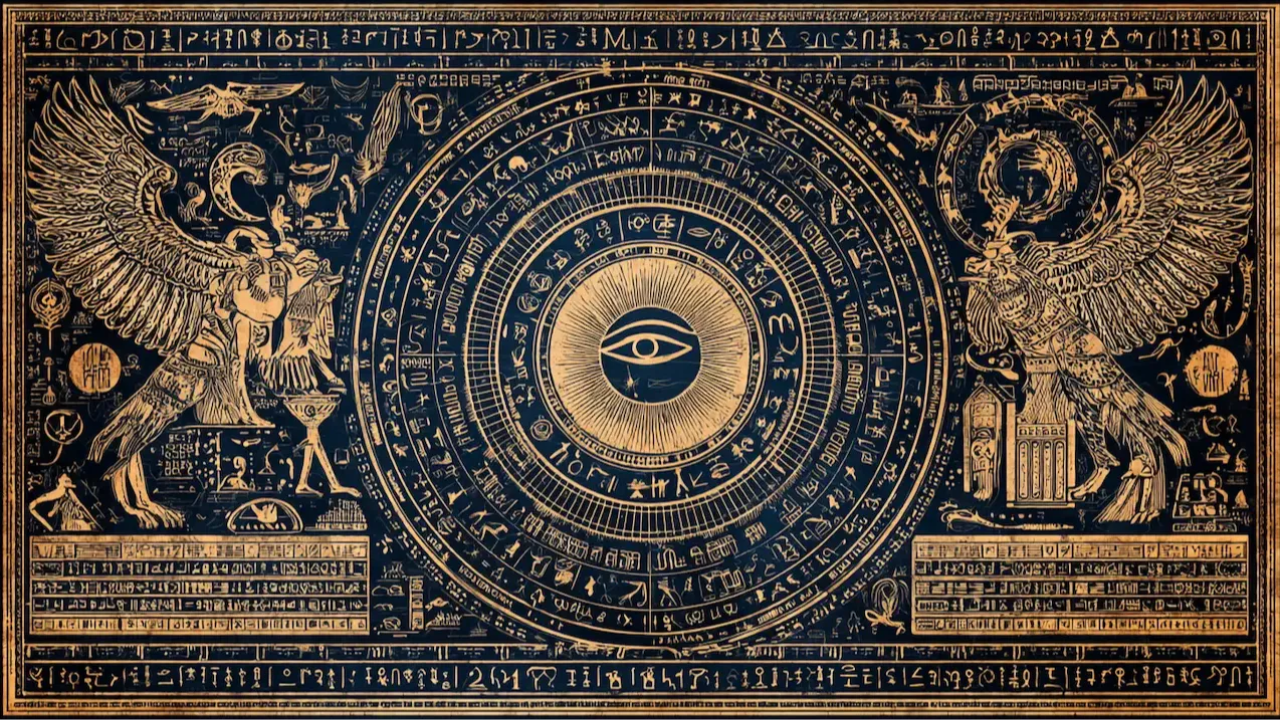
The hieroglyphs weren't just writing. They were cosmic code - each symbol carrying layers of astronomical precision, mythological meaning, and spiritual instruction. When temple priests inscribed decan tables onto papyrus scrolls or carved them into temple ceilings, they were creating maps of consciousness itself.
Your Birth Decan: Cosmic Fingerprint
Western astrology recognizes that people born under the same sun sign can differ dramatically. The Egyptian system explains why. Each zodiacal constellation was divided into three decans of ten degrees each, with distinct deities governing those segments. Two people born under the same sign but in different decans received fundamentally different cosmic imprints.
Your birth decan functioned as your soul's signature - the specific combination of divine forces active when you entered the world. This wasn't fate in the sense of predetermined outcomes. It was essence - the energetic blueprint you agreed to work with in this lifetime.
The astronomer-priests who developed this system weren't engaged in superstition. They were mapping observable astronomical phenomena (the heliacal rising of specific stars) to mythological frameworks that helped humans understand their place in cosmic order. Modern archaeology reveals their calculations were remarkably precise, tracking stellar movements with accuracy that wouldn't be matched in Europe for thousands of years.
The Sacred Architecture: How the System Works
The Egyptian decan system emerged from practical necessity. Egypt's agricultural calendar depended on accurately tracking the Nile's flood cycle, which correlated with astronomical events. Priests observed that specific stars would rise just before dawn at particular times of year - what astronomers call "heliacal rising."
They identified thirty-six star groups whose heliacal risings marked ten-day periods throughout the year. These became the thirty-six decans, each assigned protective deities based on the qualities needed during that agricultural and spiritual season.
The complete system worked like this:
Twelve months, each containing three decans of ten days each, totaling 360 days. The remaining five days were considered outside normal time - the "epagomenal days" when the boundaries between human and divine realms grew thin.
Thirty-six decan deities, each governing a specific ten-degree segment of the ecliptic. These weren't minor spirits - they were cosmic principles with temples, cults, and sophisticated mythological narratives.
Layered correspondences connecting each decan to:
- Specific stars and constellations
- Agricultural activities and seasonal energies
- Healing practices and medicinal knowledge
- Spiritual initiations and temple mysteries
- Protective amulets and sacred objects
The geometry was deliberate. Thirty-six decans divided into twelve signs creates the foundational structure still used in astrology today. But the Egyptian version operated with different underlying assumptions about consciousness, time, and human purpose.
The Temple Ceiling: Where Earth Met Sky
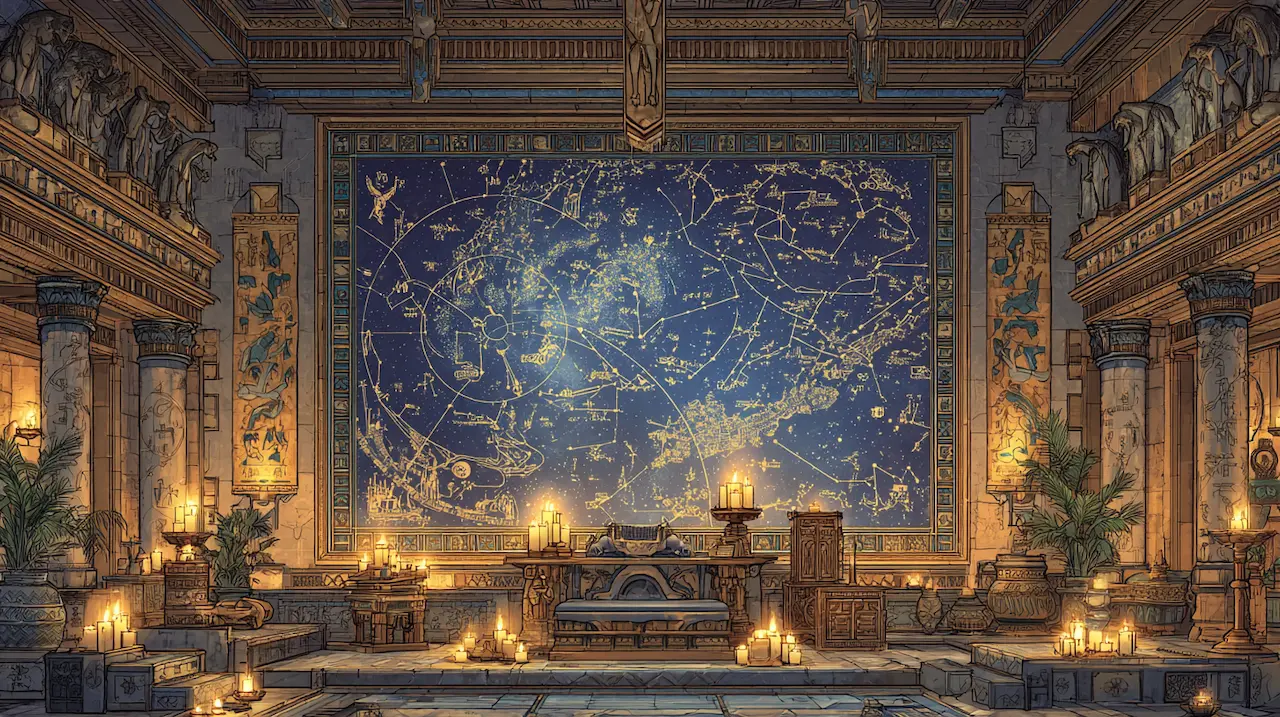
The most complete surviving example of the decan system appears on the ceiling of the Temple of Hathor at Dendera, built during the Ptolemaic period (305-30 BCE) but preserving knowledge from far earlier traditions. This astronomical ceiling, now partially housed in the Louvre, shows the complete zodiac with decan divisions and their governing deities.
Standing in that temple and looking up, ancient initiates would see their cosmic context rendered in stone - the same stars wheeling overhead now carved into sacred architecture. The ceiling wasn't decoration. It was instruction, showing how divine forces organized themselves in geometric precision above and within human consciousness.
Other temples featured similar astronomical ceilings - Esna, Edfu, Philae. Each presented variations on the decan system, suggesting both standardization (a shared framework across Egypt) and localization (temples emphasizing deities particularly important to their region).
These weren't public spaces. Temple interiors remained restricted to priests and initiates. The knowledge encoded in decan tables was considered sacred technology requiring years of training to interpret correctly. When modern archaeologists first encountered these astronomical texts, they assumed they were looking at primitive superstition. Closer examination revealed mathematical sophistication and astronomical accuracy that challenged those assumptions.
The Decan Deities: Cosmic Forces as Divine Persons
Egyptian theology didn't separate natural forces from divine beings. A deity wasn't an invisible spirit ruling over a domain - the deity was that domain's essential nature made conscious and personified. When astronomer-priests assigned specific gods to govern decans, they were identifying which cosmic principles were most active during those periods.
Thoth: Divine Measurement and Sacred Knowledge
Governing multiple decans associated with Mercury's movements, Thoth embodied the principle of precise knowing. Depicted with an ibis head or as a baboon, Thoth invented hieroglyphs, maintained cosmic records, and measured time itself.
Your soul purpose under Thoth's governance involves translating invisible patterns into visible form - writing, teaching, record-keeping, science, divination, any practice requiring you to make hidden knowledge accessible. Thoth-governed decans produce scribes, scholars, mathematicians, and those who build bridges between worlds through language.
The hieroglyphs associated with Thoth include the ibis, the writing palette, and the moon - all symbols of measurement, memory, and mediation between divine and human realms. Temple inscriptions describe Thoth as "lord of time" and "reckoner of years," positioning this deity as essential to the decan system's astronomical precision.
Ma'at: Truth, Balance, and Cosmic Order
Ma'at appears both as a decan deity and as the foundational principle underlying all Egyptian spiritual practice. Depicted as a woman with an ostrich feather on her head, Ma'at personifies universal balance - not morality in the modern sense, but the fundamental harmony required for existence itself.
Your soul purpose under Ma'at's influence centers on maintaining equilibrium - law, justice, diplomacy, healing, architecture, any work requiring you to bring disparate forces into right relationship. Ma'at-governed decans produce judges, mediators, designers, and those who can perceive when systems have fallen out of alignment.
The feather of Ma'at appears in the famous "weighing of the heart" ceremony, where the deceased's heart is balanced against her feather to determine spiritual worthiness. This wasn't judgment by an external authority - it was assessment of whether you had lived in accordance with your inherent truth. The decan system helped identify what that truth looked like for each individual.
Anubis: Threshold Guardian and Soul Guide
Governing decans associated with transitions and transformations, Anubis appears with a jackal head - the animal that prowled desert edges between cultivated land and wild chaos. Anubis presided over mummification, guided souls through the underworld, and protected boundaries between states of being.
Your soul purpose under Anubis involves navigating liminal spaces - psychotherapy, hospice work, initiation practices, any role requiring you to guide others through death and rebirth processes. Anubis-governed decans produce therapists, midwives, shamans, and those capable of holding space during transformation without trying to control outcomes.
The hieroglyphs surrounding Anubis include the jackal, the embalming tools, and symbols of the underworld journey. Temple texts describe Anubis as "opener of the ways," emphasizing this deity's role in making passages possible that would otherwise remain sealed.
Bastet: Joy, Protection, and Fierce Gentleness
Depicted as a woman with a cat head or as a seated cat, Bastet governed decans associated with home, pleasure, music, and protective fierceness. Her dual nature - domesticated cat and dangerous lioness - embodied the principle that true joy requires the capacity for appropriate ferocity.
Your soul purpose under Bastet involves creating sanctuaries - hospitality, music, dance, pleasure, any practice that generates beauty and safety while maintaining clear boundaries. Bastet-governed decans produce artists, musicians, healers, and those who understand that softness requires strength as its foundation.
The sistrum (a sacred rattle) appears as Bastet's primary symbol, used in ceremonies to drive away malevolent forces through sound and rhythm. Later mythology sometimes conflates Bastet with Sekhmet (her fiercer lioness aspect), suggesting these weren't separate deities but different expressions of the same protective principle.
Sekhmet: Destruction as Healing Force
The lioness-headed Sekhmet governed decans associated with purification through fire, surgical precision, and the destruction of what cannot be healed or integrated. While modern spirituality often shies from destruction, Egyptian wisdom recognized that certain transformations require complete annihilation of previous forms.
Your soul purpose under Sekhmet involves wielding transformative power - surgery, exorcism, revolutionary action, any work requiring you to destroy what's toxic so new growth becomes possible. Sekhmet-governed decans produce surgeons, activists, warriors, and those capable of precise destructive force in service of healing.
Temple inscriptions describe Sekhmet's breath as creating the desert - the searing wind that strips away all excess, leaving only essential structure. Her priests were often physicians, understanding that healing sometimes requires cutting away disease without hesitation or sentimentality.
Seshat: Sacred Records and Life Blueprint
Depicted with a seven-pointed star above her head, Seshat functioned as divine librarian and architect. She kept records of royal reigns, marked temple foundations, and maintained the cosmic archives where every soul's blueprint was stored.
Your soul purpose under Seshat involves maintaining sacred order - libraries, archives, sacred geometry, any practice requiring you to preserve knowledge and ensure it passes accurately to future generations. Seshat-governed decans produce archivists, geometers, historians, and those who understand that civilization depends on meticulous record-keeping.
The hieroglyphs associated with Seshat include the notched palm rib (used for counting years), the seven-pointed star (symbolizing the seven celestial bodies visible to naked-eye observation), and the writing palette. Temple foundation ceremonies invoked Seshat to ensure buildings aligned with cosmic patterns.
Beyond Sun Signs: The Sophistication of Decan Astrology
Western astrology's twelve sun signs offer broad archetypal categories. The Egyptian decan system provided thirty-six variations, each with its own mythology, ritual practices, and spiritual technologies. This wasn't complexity for its own sake - it reflected the observable fact that people born under the same solar position could manifest completely different life purposes.
The decans also tracked more than solar position. Because each decan correlated with specific stars' heliacal risings, the system incorporated sidereal (star-based) astronomy alongside tropical (season-based) calculations. This dual framework allowed priests to work with both the eternal patterns in the fixed stars and the cyclical patterns of Earth's seasons.
Modern scholars have identified several decan lists inscribed on coffin lids, temple ceilings, and astronomical papyri. These lists show remarkable consistency across centuries and geographic regions, suggesting a standardized training system for astronomer-priests. Regional variations exist, but the core framework - thirty-six decans, specific deity attributions, geometric divisions - remains stable.
What makes the decan system particularly sophisticated is its integration of multiple knowledge domains. It wasn't just astronomy, just mythology, or just spiritual practice. It was a unified system where astronomical observation, agricultural necessity, religious ceremony, and individual soul purpose all reinforced the same cosmic patterns.
Hieroglyphs as Cosmic Code
The hieroglyphic script itself functioned as part of the decan wisdom. Each symbol carried multiple layers of meaning - phonetic sound, literal representation, and deeper symbolic significance. When priests inscribed decan tables, the hieroglyphs weren't just labels - they were operative symbols that activated the cosmic forces they represented.
The hieroglyph for "star" (a five-pointed star shape) appears throughout decan texts, but its meaning shifts based on which determinatives and phonetic complements surround it. A star next to a deity name indicates that deity's celestial domain. A star inside a cartouche marks a specific decan. A star combined with the symbols for "birth" designates your natal decan.
This multi-layered symbolic system meant that initiates could read decan tables on several levels simultaneously:
Literal level: "This decan rises during the second month of inundation season."
Mythological level: "This period is governed by Anubis in his aspect as threshold guardian."
Personal level: "Souls born during this decan carry the capacity to guide others through transitions."
Operative level: "Invoking these specific hieroglyphs during this period activates protective and transformative energies."
The hieroglyphs weren't separate from the cosmic forces they described - they were the interface through which human consciousness could interact with those forces directly.
From Temple Ceiling to Personal Practice
The decan system wasn't meant to remain locked in temple mysteries. While only priests could access the complete astronomical tables and conduct official ceremonies, simplified decan wisdom filtered into popular practice through:
Protective amulets inscribed with your natal decan deity, worn to maintain alignment with your soul purpose and provide protection during difficult transitions.
Birth papyri created for wealthy individuals, showing their complete decan chart with specific deity invocations and favorable/challenging periods throughout life.
Medical texts that prescribed different treatments based on which decans were active, recognizing that cosmic energies influenced both disease and healing.
Agricultural calendars that told farmers when to plant, harvest, and conduct ceremonies based on decan transitions - ensuring human activity aligned with cosmic rhythms.
The democratization accelerated during the Ptolemaic and Roman periods, when Egyptian decan knowledge merged with Greek and Babylonian astrology to create the Hellenistic system that eventually evolved into modern Western astrology. The twelve-sign zodiac, the concept of planetary rulerships, and the emphasis on natal chart interpretation all emerged from this cross-cultural synthesis.
But something was lost in translation. The Greek emphasis on prediction and personality typing differed from the Egyptian focus on soul purpose and cosmic alignment. Where Greeks asked "What will happen to me?", Egyptians asked "What am I here to become?"
Connecting Decans to Tarot: Universal Archetypes
The decan system shares fundamental similarities with tarot's structure - both use geometric frameworks to organize archetypal wisdom. Tarot's seventy-eight cards include twenty-two Major Arcana (spiritual lessons) and fifty-six Minor Arcana (practical applications). The decan system's thirty-six deities map cosmic principles, while the five epagomenal days function like the Major Arcana - liminal moments outside normal structure where transformation becomes possible.
Both systems recognize that human experience unfolds through recurring patterns. Tarot uses suits (Cups, Pentacles, Swords, Wands) to categorize types of experience. The decan system uses seasonal divisions and elemental correspondences. Both provide frameworks for recognizing where you are in a larger cycle, what energies are available, and how to work skillfully with your current circumstances.
The Egyptian Arcana tarot deck bridges these systems by rendering tarot's archetypal structure through Egyptian artistic traditions and decan correspondences. It's not appropriation but recognition - these wisdom systems emerge from the same human need to understand consciousness, organize experience, and navigate the territory between divine pattern and individual expression.
Working with Your Natal Decan
Discovering your natal decan requires more than knowing your sun sign. You need your exact birth date and, ideally, birth time and location. Several approaches exist:
Historical reconstruction using surviving decan lists from temples and coffins, correlated with modern astronomical data to identify which stars were rising at your birth.
Hellenistic adaptation using the Greek decan system that evolved from Egyptian sources, which assigns specific decan rulerships based on planetary and zodiacal positions.
Intuitive resonance reading descriptions of the thirty-six decan deities and noting which mythologies, symbols, and purposes feel most aligned with your lived experience.
The goal isn't fortune-telling but self-recognition. Your natal decan describes your inherent capacities, the cosmic forces you can channel most naturally, and the contribution your soul contracted to make. It doesn't limit you - it clarifies you.
Once identified, your decan deity becomes a contemplative focus. Study their mythology. Research their temple sites. Examine their hieroglyphs. Notice what activities, environments, and relationships activate the qualities your decan represents. This is applied spirituality, not passive belief.
The Decan Calendar: Cyclical Wisdom
Beyond natal decans, the thirty-six-decan cycle continues throughout your life. Every ten days, a new decan rises, bringing different energies and opportunities. Tracking these transitions creates a rhythm more nuanced than monthly moon phases but more manageable than daily planetary shifts.
Traditional Egyptian practice included:
Decan festivals when specific deities were honored with temple ceremonies, public celebrations, and personal devotions - opportunities to align with those forces regardless of your natal decan.
Decan meditations where initiates contemplated each deity's qualities during their active period, building relationship with the full spectrum of cosmic principles.
Decan offerings - specific incense, foods, or ritual objects presented to each deity during their governance period, maintaining reciprocal relationship with divine forces.
Modern practitioners can adapt these practices without requiring literal belief in Egyptian theology. The decan cycle provides a framework for noticing subtle energetic shifts, experimenting with different archetypal energies, and developing more sophisticated awareness of how cosmic patterns influence consciousness.
The Sacred Marriage: Astronomy and Spirituality
What makes the Egyptian decan system particularly powerful is its insistence that spiritual wisdom must align with observable astronomical reality. These weren't priests making up arbitrary symbolic systems - they were tracking actual stellar movements and correlating those movements with agricultural, psychological, and spiritual patterns they observed over centuries.
Modern spirituality sometimes divorces inner experience from external measurement, treating subjective feeling as the only valid evidence. Egyptian wisdom maintained that authentic spiritual knowledge produces observable results - healthier crops, more effective medicine, accurate time-keeping, successful navigation.
The decan tables functioned as both astronomical almanacs and spiritual technologies. They predicted Nile floods (practical survival information) and identified favorable periods for temple initiations (spiritual transformation). They weren't separate domains but integrated applications of the same cosmic understanding.
This marriage of precision and mystery, measurement and meaning, outer observation and inner transformation - this is what modern seekers can reclaim from the decan tradition. You don't have to choose between scientific rigor and spiritual depth. The Egyptians didn't.
Your Soul's Blueprint Written in Stars
The night sky the ancient Egyptians observed is the same sky visible today. The stars have shifted position due to precession, but the patterns remain. When you look up and see Sirius rising just before dawn (as it still does in late summer), you're witnessing the same astronomical event that triggered the decan system's development four thousand years ago.
Your birth moment locked in a specific configuration - particular stars rising, setting, culminating overhead. The decan system offers a framework for understanding what that configuration means, what capacities it activated, what soul purpose it illuminated.
This isn't determinism. Your decan doesn't predict your future or limit your choices. It describes your essence - the particular flavor of consciousness you bring, the cosmic forces flowing most naturally through your being, the contribution your existence makes to the larger pattern.
Ancient Egyptian wisdom recognized what modern depth psychology rediscovered: we don't create ourselves from nothing. We arrive carrying templates, tendencies, and trajectories. The question isn't whether you have a soul blueprint - the question is whether you'll learn to read it accurately.
The thirty-six decans, their governing deities, the hieroglyphs encoding their wisdom - these are technologies for reading that blueprint. They're maps of consciousness rendered in astronomical precision and mythological richness, offering coordinates for the journey from who you are to who you came here to become.
Explore the complete Egyptian Arcana tarot deck →
Want to understand the visual language behind this wisdom? Read our complete guide to the art traditions shaping the Egyptian Arcana deck.
Ready to Go Deeper?
From beginner-friendly courses to hand-illustrated tarot decks — everything you need to build real confidence with the cards, in one place.